Cow Talk For Elk
Imitating the mews and chirps of cows and calves can lure in bulls before, during, and after the bugling season.
By Jim ZumboThe small elk herd walked steadily toward me, intent on seeing who I was. The first elk, the lead cow, seemed confident that all was well. She led her group within 50 yards, and I was able to look over the entire band. It included four cows, three calves, and a modest five-point bull.
Suddenly the wind shifted, carrying my scent to the animals. I made no effort to work the wind, but sat there and watched until the inevitable happened. The elk winded me and quickly disappeared into the timber. I sat for a while longer on the ground, chuckling over what I'd seen.
It was early November, long after the breeding season. Elk were unresponsive to bugle calls, but I was able to lure those animals in with the small device I held in my hands - a call that perfectly mimicked a cow elk.
I left the woods happy. Though elk season was over, I learned something new that day. All the stories I'd heard about the cow call were probably true because I'd seen the results with my own eyes.
I continued using the call under varying circumstances, and the results convinced me that it would offer an entirely new aspect to elk hunting.
Recently, we've learned that by imitating a cow elk, we can add an exciting new dimension to elk hunting before, during, and after the bugle season. We haven't really learned something new regarding cow calls; we've learned something old, something that's been going on long before Lewis and Clark made their epic journey into the heart of elk country in 1805. It's very likely that Indians mimicked female elk as they hunted.
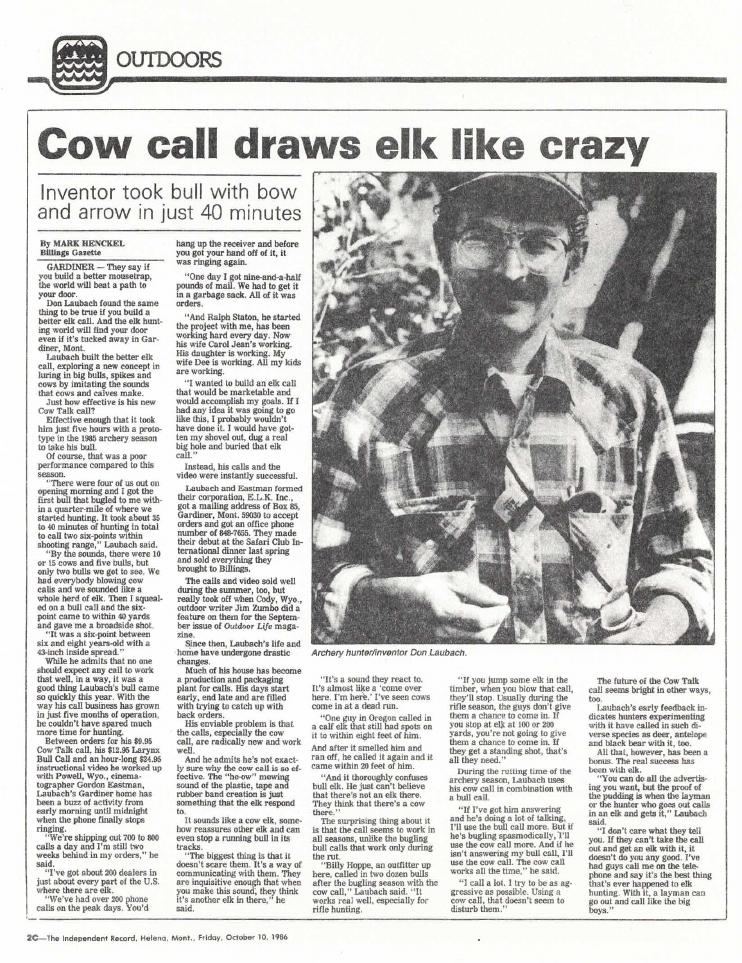
Several years ago, Don Laubach gave me a strange looking object and told me it was a prototype of a cow call he'd invented. Laubach, an avid elk hunter and good friend of mine, owns several businesses in Gardiner, Montana.
When I tried the call, my first reaction was positive. I recall wistfully wishing that I'd thought of it first. The idea was not brand-new because any of the diaphragm calls on the market will imitate cow elk, but Laubach's call was external and easily learned.
Several other hunters and outfitter pals of Don's experimented with the call and were immediately impressed. I wasn't surprised because the concept was solidly based in logic.
A cow elk makes a sound resembling the mew of a kitten or the chirp of a bird, depending on your imagination. The call most certainly does not sound like it's being made by an animal that can weigh 500 pounds or more.
I first heard cows and calves talking more than 20 years ago when I was bowhunting mule deer. It was late August, and I was sitting on a slope taking in the sun's warm rays. From across the canyon I heard interesting sounds that could have been produced by a bunch of alley cats. I assumed a flock of pinyon jays or other birds was stirred up, probably by some thieving magpies or a hawk.
I stared in disbelief when 40 head of elk strolled into a meadow, and it took several minutes of intent glassing with binoculars before I was convinced they'd been making the sounds.
The cow call I'm referring to must not be confused with the bark. When a cow barks, your number is up. You've been had, and you can bet your pet rifle she'll sashay for safer parts, taking the herd with her.
Cows and calves talk to each other all year long, which affords a new trick in the hunter's bag. Think about it. Heretofore, we've used bugle calls during the breeding season to encourage a bull to waltz out where we can take a poke at him. But before and after breeding season, bugle calls are worthless. Moreover, bugle calls are often ignored during the prime days of the breeding season for a whole bunch of reasons, including weather, hunter pressure, and the attitude of the bulls being pursued.
I had an experience last fall that sold me 100 percent on cow calling during the breeding season. Hunting in British Columbia's east Kootenay Mountains with a group of hunters hosted by Bushnell Corporation, I had absolutely no luck with a bugle call. The weather during the 1987 elk season was extremely hot, and bulls were holed up in the heaviest cover they could find. Occasionally a bull would respond, but he'd melt back into the timber. If he was a herd bull, he'd take his cows with him. If he was a loner, he'd refuse to meet the challenge.
On the seventh and eighth days of the hunt, a bull responded vigorously to bugle calls, but he'd eventually lose interest and retreat deep into the forest. When the same thing happened on the ninth morning, I tried a cow call. I was about to give up when the bull suddenly appeared in a small meadow and walked directly toward me. He had come in silently, obviously interested in the new cow in his territory. I was able to tie my tag to his antlers because of the cow call, and I'm convinced the hunt would have been unsuccessful without it.
When hunting during the rut, you'll be dealing with three kinds of bulls - the herd bull, the mature bull without cows, and the spike. The herd bull is usually the toughest to call because he already has his girls and is often reluctant to meet a challenger.
The elk I outsmarted in British Columbia was a herd bull. I know because I heard his cows talking. My cow call completely fooled him.
Loner bulls can be big mature animals that have been unsuccessful in gathering a harem, or 2 1/2-year-olds, generally four- or five-points, that are commonly called satellite bulls. They'll usually respond to a bugle call, but frequently they'll keep their distance. If so, the cow call is a natural. What more enticing way to lure in a love-starved bull than with a female's calls?
The spike bull is sexually mature, but he isn't quite sure what's going on. He'll be kicked out of herds by the master bull, and will constantly try to rejoin his brethren. Hearing a cow call means his momma and other ladies are close by, and he'll often bounce in for a look. A bugle call might keep him at a healthy distance, but the cow call could work wonders.
So far I've described situations during the rut. How about before and after it? Some states offer archery elk hunts that begin in August. At that time, bugling is often ineffective because breeding season is weeks away. Nonetheless, bulls will often respond to cow calls as a matter of curiosity or simply to get a head start on harem gathering.
Since cows will come to cow calls, they're often welcome because many bowhunts offer either-sex hunting. It's always possible, too, that cows will bring bulls in with them.
Most rifle hunts begin around mid-October and later, when breeding season is long over. Bulls are no longer vocalizing, but are passing the time in timber where they aren't disturbed.
This was the case when I used the cow call in early November, just to try its effectiveness. Being gregarious animals, elk like to hang out together. The cow call coaxes them to come see who the newcomers are.
Calf elk make the same mew or chirp as the cow, but it's higher pitched. By sounding like a calf in distress or a lost calf, or simply a noisy calf, the maternal instincts of cow elk take over, and they'll often saunter in for a look.
Again, cow elk are legal game in most western states, sometimes during regular seasons and sometimes during special permit hunts.
There's yet another superb strategy afforded by the cow call, and it has nothing to do with attracting an elk. Let's say you're walking through elk woods and spook elk. If the animals haven't winded or spotted you, but were alarmed by the noise you made, you can often stop them in their tracks by softly blowing the cow call. This tells them another elk is moving through, and puts them at ease. Not only will they stop running, but they'll often approach to investigate. There's no guarantee this will work, but it's worked for so many hunters, including myself, that it's worthy of serious consideration.
Many hunters blow the cow call every few minutes while walking. This tactic causes elk within earshot to think other elk are traveling about, and you can get away with making some noise. Elk are noisy animals. They're big, and they live in a brittle environment where branches and leaves snap and rustle. A certain amount of noise will often be tolerated.
Finally, the cow call can be used to lure an elk back into range if it's shot at or missed. This sounds farfetched, but it indeed happens. Even more incredible is the documented fact that wounded elk will often stop when they hear the cow call, often offering another shot. This technique works best for bowhunters, but it has worked for rifle hunters as well. It will not work, however, if the elk smells or spots you.
The cow call doesn't work miracles, but it is definitely a tool that should be considered by every serious elk hunter. Keep in mind that the national hunter success average among elk hunters is less than 30 percent. That means seven of every 10 hunters go home without an elk. If you want to be one of the three successful ones, use every trick you have. The cow call is near the top of the list.
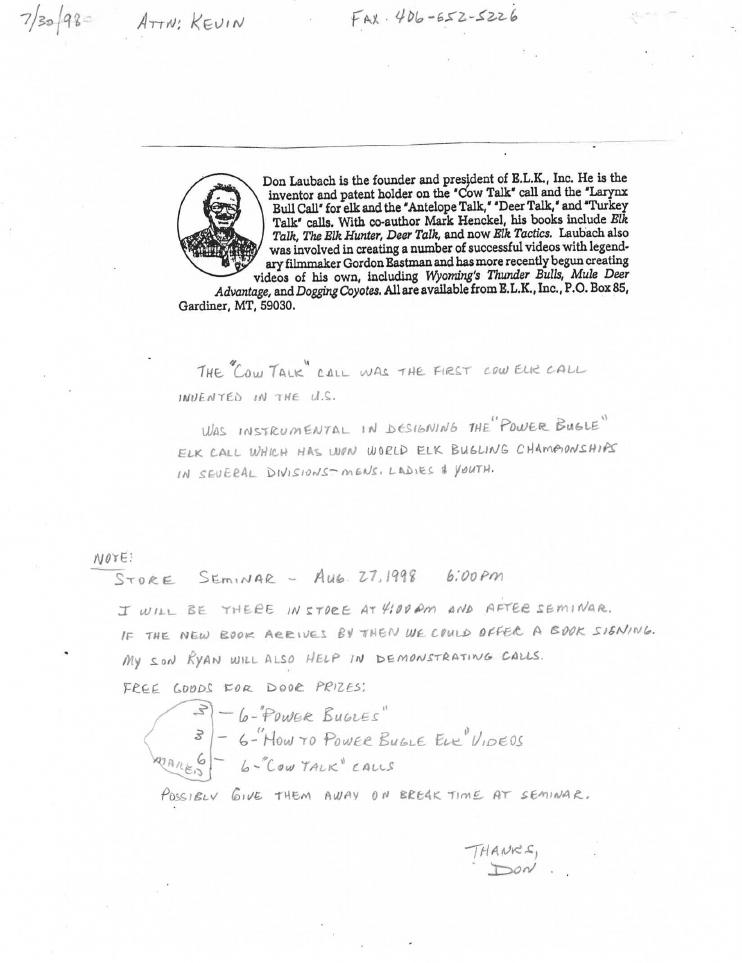
For more information on Don Laubach's cow call, write: E.L.K. Inc., Box 85, Dept. AH, Gardiner, MT 59030.
 October 10, 1986
 October 12, 1986
 July 30, 1998